
Crown Feels Too High: A Bite Check
- A crown that feels high is a reason for a check-up, not necessarily for replacing the crown.
- It helps to note exactly when the teeth touch and in which area.
- Adjustment and a follow-up visit are agreed by the dentist after assessing the contacts.
If an “extra” contact appeared when your teeth close after a crown was fitted, do not wait for it to sort itself out. Describe the sensation precisely — it helps the dentist find the spot that needs checking.
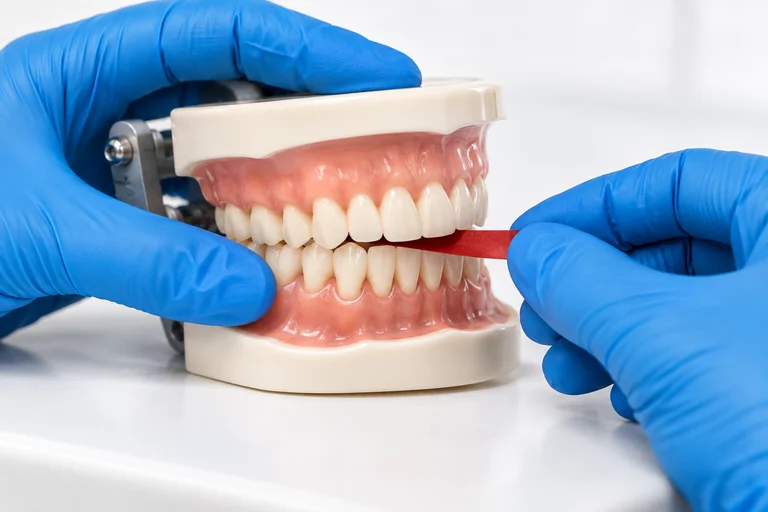
What a “high” crown feels like
Patients describe the same thing in different ways: “the crown gets in the way”, “this tooth touches first”, “my jaw no longer closes as before”. These are subjective sensations and do not point to a cause on their own.
A new restoration changes how the upper and lower teeth meet. Even a small difference can be noticeable because the tongue and chewing muscles react to tiny changes. Whether any action is needed is decided by the dentist at the examination.
What to report before the visit
The more specific your notes, the easier it is for the dentist to reproduce the situation. It helps to answer these questions:
- When it occurs: when closing, chewing hard food, swallowing, at rest.
- Which area: right or left side, upper or lower jaw.
- Whether the feeling changed after cementation: better, worse or the same.
- Whether there is pain, sensitivity to cold or pressure on neighbouring teeth.
Do not file the crown down and do not try to “chew it in” — this can make things worse.
What is checked in the contacts and load
The dentist usually assesses how the teeth meet in different jaw positions, how the load is distributed and whether there is a premature contact on the new restoration. Special articulating paper may be used to mark contacts.
The neighbouring teeth and the condition of the supporting tooth are assessed separately. This helps to tell a “high” contact from other causes of discomfort.
How adjustment and follow-up are agreed
If a premature contact is confirmed, the surface of the restoration is adjusted. The extent and need for this is decided by the dentist. After adjustment a follow-up visit is usually arranged to make sure the feeling is stable.
If the discomfort does not go away or comes with pain or swelling, tell the administrator: if necessary, an earlier time or a consultation with the duty doctor can be offered.
Observation form before the visit
- When the teeth touch (closing, chewing, at rest)
- Which area: side and jaw
- Date the crown was cemented
- Whether the feeling changed after cementation
- Any pain or sensitivity
- What you have already done yourself (nothing should be filed down)
Print or save the form and bring it to your appointment.
Questions and answers
Does a feeling of height mean the crown must be replaced?
No, not necessarily. Often it is enough to assess the contacts and, if needed, adjust the surface. Replacement is discussed only after an examination, if adjustment does not solve the problem.
What sensations should I describe to the dentist?
Describe which tooth touches first, whether there is pressure, pain or “interference”, and during which movements it appears: closing, chewing, side movements.
Read also
Crown Try-In: What to Discuss Before Cementation
Dentika in Lutsk: agreeing shape, shade and comfort at a crown try-in. Information for your restorative consultation.
A Dental Bridge Feels Loose: What to Report
Dentika in Lutsk: describing movement in an existing bridge when arranging an appointment. Information for your restorative consultation.

Denture Review: A Symptom Diary for Your Visit
Dentika in Lutsk: a structured note on fit, speech and chewing for a specific review. Information for your restorative consultation.
The material is for reference and does not replace a doctor’s consultation. The text was prepared by the site editors; review by a clinic doctor is in progress.